The view from the mid-market
02.02.2026| 8 min
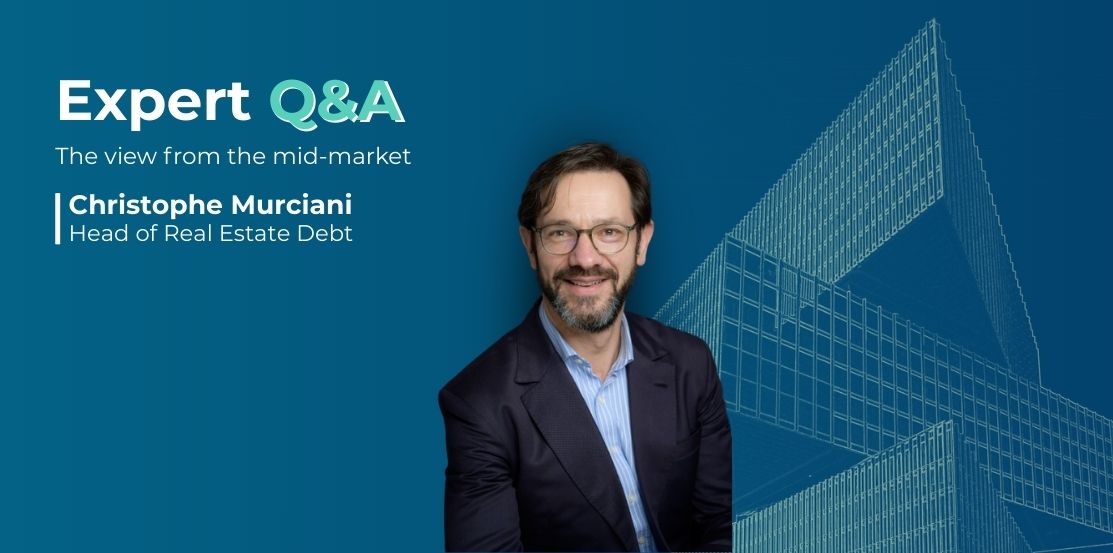
In this Expert Q&A, Christophe Murciani, Head of Real Estate Debt at LBP AM European Private Markets, explains why his team is adopting a more granular approach to real estate debt opportunities in the mid‑market.
As we go into 2026, what were the main takeaways about real estate debt investing in Europe last year?
Shrinking investment volumes were one of the main themes of the market in 2025, with lower investment volumes leading to lower new debt origination and the refinancing of existing transactions. Private equity similarly found that exits were not as easy to complete as had previously been expected. We have not yet seen continuation funds in real estate, but we are seeing more examples of capital recycling in the market, which has led to an increased polarisation between property qualities. Healthy income generation, strong locations and solid tenant covenants have become a core focus of the investment and debt analysis, especially in the logistics sector. Logistics has been supported by an increase in rental values over the past few years, but now focus at the underwriting stage – both for the equity and the debt – is shifting to tenant quality and financial strength. There’s a growing competitive pressure on finding the best assets and the best sponsors.
Another feature of the 2025 market is that better-capitalised, all-bank lenders were chasing the same deals. While that situation advantaged borrowers, there has been less liquidity available in the market for older buildings in less desirable locations. That can present opportunities for certain lenders, however.
What do you see as the biggest challenges this year for real estate debt investment in Europe?
The Basel Committee on Banking Supervision’s Basel IV regulatory framework is yet to be finalised, and it is unclear how much impact this will have on the availability of debt finance and the ability of banks to roll positions. The uptick in refinancings from last year means that Basel IV will likely take a closer look at what the regulator calls ‘forbearance’. It is perceived in lieu of writing the loan down, or classifying the loan as default, which has consequences on the cost of capital for the incumbent lenders.
Where do you see the strongest opportunities in this asset class?
We’ve essentially been a syndication participant in relatively large volume transactions for the past 12 years, but there is growing market demand on the borrower side for us to shift to direct, mid-market deals. We feel the mid-market is really underserved and we want to take a more granular approach to our investments in this space. As such, we’re increasingly looking to partner with sponsors that might not necessarily have the right connections in a given geography or industry to invest effectively – for example, a Dutch sponsor making their first acquisition in France. There’s also an additional benefit to our fund investors if we are the sole lender on a transaction, because it’s much easier to adapt and react to different situations if you are able to manage your loan in a direct bilateral relationship with the borrower and increase recovery in a tricky situation. This also puts us in a good position to carve out some improvements to a building’s environmental, social and governance principles. We want to focus on properties that are already in existence but need a massive upgrade to be more energy-efficient and sustainable, which translates to quicker leasing times, better disposal values and a better risk profile.
To what extent will sustainability still have economic relevance to the asset class this year?
LBP AM European Private Markets has had ESG objectives in place for about 10 years now, with a dedicated sustainable investment team serving across all our strategies. There is ample evidence that tenants are willing to pay a premium if a property has the right ESG credentials. This allows you to lease faster and for a better price, before selling at a premium. We see a lot of opportunities in the market for this kind of ESG value creation. In Paris alone, there are annually around 25 deals in the mid-market segment that cover 1,000-3,000 square meters, and this represents typical deal volumes for the city. If you create a fund that targets these properties, you only need to close three or four deals each year, meaning the opportunity set supports selectivity. We target loans where the borrower has a solid business plan to improve the property’s energy efficiency, waste management and water treatment on-site facilities. This mission is particularly relevant to city-centre offices and warehouses serving as last-mile facilities. Interestingly, despite all the noise around new employment models and remote working policies, office vacancies are below pre-pandemic levels in most European city centres.
When it comes to adapting existing stock in 2026, how else will you aim to create value?
We recently hired a civil engineer to help us refine our strategy and check if assets’ capital expenditure programmes are fit for purpose. Our in-house teams will be focused on making sure the properties we finance adhere to carbon risk real estate monitor (CRREM) decarbonisation pathways for their respective asset classes and locations, to help make this process as prescriptive as possible for borrowers. One route to creating value is for central management systems to monitor a specific asset in real time. In those instances, we would debate the specifics of the system with a borrower ahead of making the investment, but it’s important to have the relevant KPIs and capex monitoring processes in place.
What excites you most about the year ahead and what it holds for the asset class?
We’re looking forward to 2026 because we’re going back to the market with a new fund, which we haven’t done in a while, simply because investor demand has been subdued. A lot of firms focus on ESG, but they would usually do so through syndicate participation, rather than direct and bilateral lending, which is our preference. We want to be upfront with our borrowers and monitor the evolution of the portfolio over time, which will, in turn, help us to illustrate our impact to investors.