Offering a distinct universe
01.04.2026|11 min
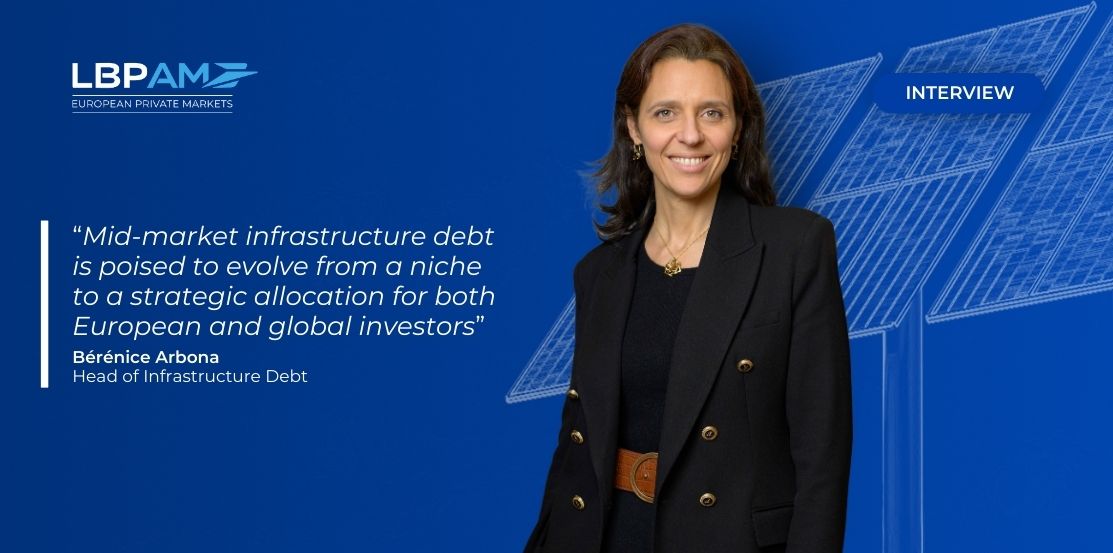
Mid-market infrastructure is not just a scale-down version of the large infrastructure space, says Bérénice Arbona at LBP AM European Private Markets.
The mid-market is the most active and diversified segment of the infrastructure asset class, representing 87 percent of transactions last year. From a lender’s perspective, meanwhile, it offers favourable pricing and terms and conditions, given lower levels of competition.
To be successful in the mid-market, however, debt must display speed and flexibility.
Relationships are also paramount. Borrowers want to know precisely who they can pick up the phone to, explains Bérénice Arbona, head of infrastructure debt at LBP AM European Private Markets.
“Mid-market infrastructure debt is poised to evolve from a niche to a strategic allocation for both European and global investors”
How do you define mid-market infrastructure and why is this a space where you choose to spend your time?
For us, mid-market infrastructure refers to assets or platforms that are smaller in scale than traditional large cap projects but remain economically essential. This can involve regional or local assets that are structured around moderate capital requirements and that offer long-term contractual or mid-market depends on which position on the risk curve and within the capital structure we’re looking to take. With our senior investment grade strategy, we focus on transactions that are on the smaller side of the spectrum. Although senior deals in market tend to be relatively large, we deliberately target the smaller end of the mid-market, where we find robust fundamentals coupled with the opportunity to have a stronger influence on structuring and governance. This part of the market also offers strong diversification for investors, with a lower risk of overlap with other asset managers.
In contrast, with our high yield strategy, although individual ticket sizes are similar, the underlying transactions are typically at the higher end of the spectrum, as high yield financing generally represents a smaller share of a company’s enterprise value.
In other words, we’re flexible but intentional about where we focus within the mid-market depending on the part of the capital stack that we’re targeting.
Where are you seeing the most interesting mid-market deployment opportunities right now and what are the key drivers?
We categorise our sectoral convictions into three main buckets. The first is the energy transition. The energy transition contains a number of themes that are in line with a mid-market focus. Renewable energy remains a core pipeline for us.
We primarily target the development of renewable platforms with strong expansion potential and the growing universe of behind the meter solutions, including decentralised solar for industrial clients.
Another interesting area is what we call renewables plus – renewables combined with storage, or renewables integrated with load intensive assets such as data centers. It’s also possible to combine all three, of course.
The second category of assets that we like involves what we call strategic infrastructure. Recent political developments have reinforced the importance of infrastructure that supports European autonomy and resilience. Lower mid-market assets have a critical role to play in that context. Relevant investment themes include transportation and logistics, as well as digital telecoms assets. I would also include essential local services such as education and healthcare in the strategic infrastructure bucket given their importance in ensuring Europe remains resilient and competitive.
The last of the three buckets we call growth infrastructure. This refers to infrastructure that supports economic growth by scaling up local and regional players, enabling them to build resilient platforms. That can include digital platforms and renewables platforms, as well as community infrastructure.
What evolutions are you seeing with regards to terms and pricing in the mid-market?
We’re seeing increased selectivity from lenders in this space due to macroeconomic uncertainty, which has in turn led to better pricing. There’s also moderate spread compression when compared to larger transactions.
Equally important is the focus on covenants and tailormade financial solutions in the mid-market. Lenders and borrowers work hand in hand to determine the structure that best fits the specific risk profile of the transaction. Larger deals, by contrast, tend to involve more intermediaries and lead arrangers, resulting in standardised terms and conditions.
For us, a good deal is when the documentation is balanced, the risks clearly allocated to the party best able to bear them, and where the financial structure leaves adequate room for the asset to perform, even in a stressed scenario. We definitely view the mid-market as being more attractive than the larger deal market in terms of both pricing as well as terms and conditions.
“We’re seeing increased selectivity from lenders in this space due to macroeconomic uncertainty, which has in turn led to better pricing”
How would you describe competitive dynamics in lower mid-market infrastructure debt from both a borrower and limited partner perspective?
There’s no doubt that competition is increasing, even in this segment of the market. But we nonetheless believe that competition remains far more moderate than it is for larger transactions. In the large transaction market, we see significant competition, not just from local players, but from global players as well.
This is particularly evident right now, given current market conditions. It still amazes me to see US or Asian lenders targeting local European rolling stock assets, for example. As long as there’s an external rating on the transaction, global competition will be there.
That’s not to say that the mid-market is not competitive, of course. We try to differentiate ourselves in a number of ways. Firstly, we have deep sector expertise. LBP AM European Private Markets has been financing infrastructure projects for more than 13 years, so we have a track record of investment in all different types of infrastructure and across all the key European markets. We have a good understanding of all the different regulatory frameworks and of the different asset types that exist.
The second way that we aim to differentiate ourselves is through flexibility and speed. Big players are typically less flexible, being constrained, to an extent, by standardised investment processes. We try to bring value to sponsors by virtue of being flexible and agile, reacting quickly to attractive investment opportunities as they arise.
The ability to tailor debt structures is also very important, particularly today when regulatory frameworks and industry dynamics are evolving so quickly. There’s no project financing handbook that spells out how to finance a specific project. You need to take into account what you’ve seen in the past in different contexts and then tailor it to fulfil the specific dynamics of a given situation.
Finally, infrastructure debt is a relationship-driven business, especially in the mid-market. Borrowers and investors alike come to you, because you make the difference. They may have worked with you in the past, they know how you think, how constructive you can be on the investment side and how strict you are in your risk policy.
In the larger deal market, however, differentiation tends to come down to execution capabilities and whether they fit with the requirements of the arranger that’s put the transaction in place. In the mid-market, relationships are paramount.
Once a transaction has closed, for example, the borrower wants to know who they can pick up the phone to, to talk about business growth plans or waivers. They don’t want to be left trying to figure out who in a worldwide platform they should be speaking with. The same is true with investors. LPs want to know who they can talk to to better understand a particular sector or who’s best positioned to answer their question.
How do you see the lower mid-market infrastructure debt space evolving?
Mid-market infrastructure debt is poised to evolve from a niche to a strategic allocation for both European and global investors, especially given the structural drivers that are in place. Those drivers include the acceleration of the energy transition, digitalisation, sovereign needs and the modernisation of ageing infrastructure. The appeal of the mid-market is also likely to grow given limitations to larger funds’ deployment capacity. We strongly believe that as the segment continues to institutionalise, platforms like LBP AM European Private Markets that can provide access and disciplined selection will have an increasingly central role to play in connecting investors to real and local economies.
What role does ESG play in mid-market lending today?
ESG is absolutely central to our investment philosophy. It’s not a nice-to-have, but a core requirement, in line with our DNA as asset manager. Our strong conviction is that extra-financial and ESG analysis has a central role to play in the determination of value of an infrastructure asset, and so we conduct detailed due diligence on every deal.
ESG is fully integrated into our risk assessment and pricing because we view it as far more than just a box-ticking exercising. We believe ESG is a key value creation driver for infrastructure.