Tapping into Europe’s unique growth drivers
01.05.2026|13 min
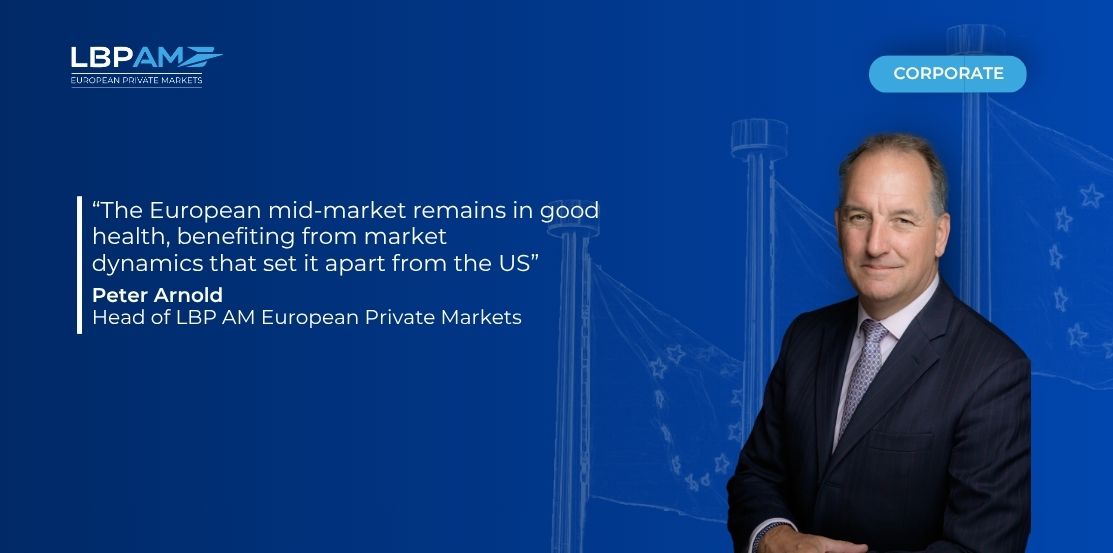
The European mid-market remains in good health, benefiting from market dynamics that set it apart from the US, says Peter Arnold, head of European Private Markets at LBP AM.
How would you describe the state of the European corporate direct lending market?
The market is healthy, but that statement requires some context. At this late point in the credit cycle, Europe continues to benefit from structural growth drivers in direct lending, particularly when compared with the US. Europe only started its evolution towards using non-bank lenders following the global financial crisis and the banks still represent an important part of the regional corporate lending market.
What we are seeing now is the unitranche players, of which there are many, increasing their market share in the mid-market and lower mid-market.
As such, we see that the European corporate direct lending market is maturing and growing in complexity. We do not see underwriting standards or leverage levels shifting materially, and pricing is the most competitive area of the market.
Are you seeing significant differences between the US and Europe in terms of resilience and risk-return profiles?
We see differences on three levels, all of which have contributed to greater resilience in Europe. First, the European market structure is relatively unique: retail clients remain heavily underweight in private markets and managers remain institutionally orientated, in sharp contrast with the US, where BDCs account for between a third to a half of total direct lending.
Private BDC and 40 Act funds that are based on private credit have grown tremendously over the past few years compared with their European counterparts, leading to some dispersion of performance and concerns around underwriting standards among some US managers.
The final key difference between the two markets is the composition of underlying portfolios. In Europe, companies have been prudent around balance sheets throughout the covid-19 pandemic, the Ukraine conflict and the current energy crisis, and lenders have been similarly cautious, so there is less leverage present in these assets than in comparable businesses in the US.
What changes have you seen in leverage levels, covenant packages and documentation in recent years?
We are not seeing more leverage in the market as a rule. We fish in the first lien pool where we stick to around three and a half or four times leverage, and we find plenty of deals there without having to extend ourselves. There may yet be some leverage movement at the larger end of the market but that has not appeared on our radar. A smaller company in the US is probably carrying around an additional half a turn of leverage than an equivalent company in Europe.
We also do not see covenant packages or documentation changing much in the coming months. We feel there may be more of a shift on pricing than anything else, given the liquidity among banks and non-bank lenders.
In a more volatile environment, what are the key levers for anticipating and managing credit risk?
Following the completion of a deal, we have our people follow the credits closely to make sure they are performing to our underwriting expectations. We also stay very close to management – significant change in the C-suite is usually a red flag.
We also look closely at a company’s position in their respective supply chains, or whether they have dominance in a niche market. If they are key to a supply chain, you will typically see things break around them before they break, so that is a good early warning system. Dominance in a niche also provides more resilience to inflation.
One thing we focus on is what we call ‘the China effect’, which is the risk that the company is making or doing something that China could do in a more cost-effective way.
What role does corporate direct lending play today in financing European SMEs and mid-sized companies?
There are three perspectives that we consider to be crucial for private debt development in this segment of the market: financial non-sponsored opportunities, minority-sponsored deals and leveraged buyouts.
If you are pursuing a non-sponsored deal as a borrower, you do not want to be diluted in your equity, so you should look for a debt package that will support growth. This need may be satisfied by a bank, but alternative lenders can also offer an attractive proposition.
The concept of a minoritysponsored deal is much more common in Europe than the US, whereby family businesses are looking to grow and often bring in private equity capital to help. They want to create a more efficient capital structure, which is where private debt can play a role. Classic leveraged buyouts also remain popular.
We look at SMEs and mid-sized companies across Europe and see a huge opportunity to contribute to GDP growth, innovation and employment. In our last fund, we analysed the performance of our underlying companies and found that EBITDA grew by 20 percent on an annual basis across that portfolio, with employment also up 20 percent. In this way, direct lending can be viewed as an important driver of the real economy.
Do you see environmental, social and governance issues primarily as a risk management tool or as a lever for value creation in private debt?
Both work in tandem and are therefore of equal importance. A focus on ESG helps to build resilience in a business, reduces risks associated with litigation and builds value. We evaluate ESG factors as much as financial factors when we review borrowers on an annual basis. A company with an ESG problem has broader problems that it needs to address, while a company that is taking the lead on reducing carbon impact or using more eco-friendly inputs will benefit on numerous levels.
What do you see as the main drivers of opportunity in European direct
lending over the next 12-24 months?
You cannot ignore the long-term effects of artificial intelligence, so we spend a lot of time trying to understand where that will have a positive or negative impact across our portfolio.
We are also trying to isolate the impacts of geopolitical uncertainty, looking for companies that are not subject to tariffs, for example, or that show resilience to energy cost volatility.
Broadly speaking, we are agnostic on sectors and where we deploy across the capital structure – the key thing that managers should be asking themselves is where they can find true value.
How do you see the role of corporate direct lending evolving within institutional portfolios over the medium to long term?
As the market matures, direct lending is always going to be an important part of private credit portfolios. The strategy has consistently given money back to investors because it has a maturity and a coupon.
Over time, we may see corporate direct lending become slightly less dominant than it is today as people look to diversify across private credit and into areas like infrastructure debt and asset-backed lending. As private credit allocations continue to grow, however, the outlook for corporate direct lending continues to look strong.
